
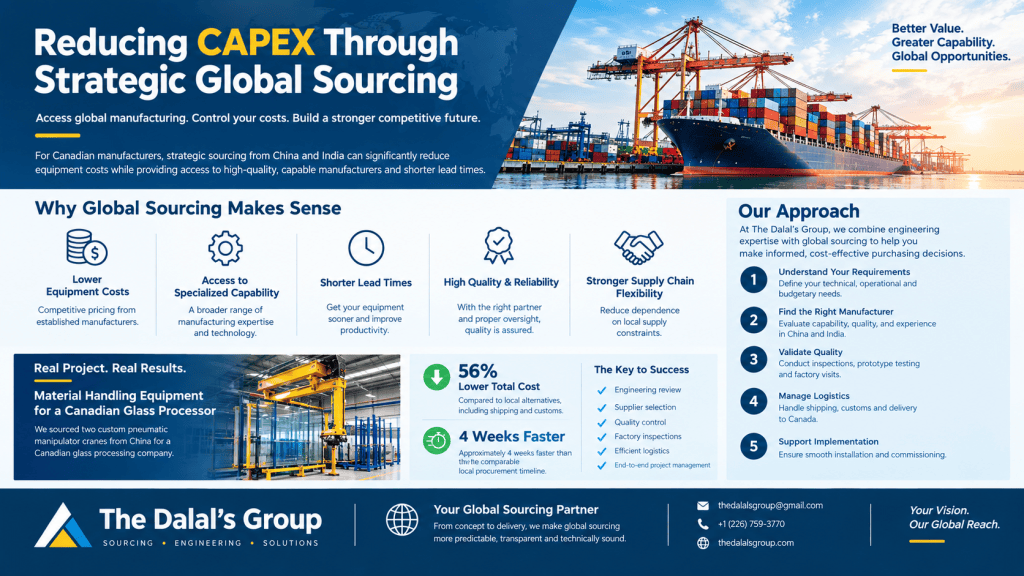
For manufacturers, capital expenditure decisions can have a significant impact on profitability, cash flow, and long-term competitiveness. Whether investing in machinery, material handling systems, or custom industrial equipment, finding the right balance between cost, quality, performance, and lead time is critical.
Strategic global sourcing can provide Canadian manufacturers with access to capable manufacturers in markets such as China and India, often creating significant opportunities to reduce equipment acquisition costs.
At The Dalal’s Group, we combine engineering knowledge with global sourcing to help clients evaluate these opportunities and make informed purchasing decisions.
1. Look Beyond the Equipment Price
A common mistake when comparing local and overseas suppliers is to look only at the quoted equipment price.
The real comparison should be based on total landed cost, including:
- Equipment manufacturing cost
- Engineering and customization
- Packaging
- Ocean or air freight
- Customs duties
- Brokerage
- Inland transportation
- Installation and commissioning
- Required modifications
An overseas quotation may appear attractive initially, but the additional costs must be understood before making a purchasing decision.
At the same time, a properly evaluated overseas solution can remain significantly more cost-effective even after these expenses are included.
2. Start With the Engineering Requirement
Cost reduction should never begin with simply asking, “Who can build this the cheapest?”
The first question should be:
“What exactly does the operation require?”
This includes understanding:
- Required capacity
- Operating environment
- Duty cycle
- Safety requirements
- Available space
- Power requirements
- Operator interaction
- Integration with existing equipment
- Applicable Canadian requirements
A clearly defined specification gives manufacturers a common target and makes supplier comparisons much more meaningful.
3. Compare Local and Global Options Fairly
Local manufacturing can provide advantages such as proximity, communication, service support, and shorter logistics distances.
However, global sourcing can provide access to a much larger manufacturing ecosystem and competitive production costs.
The objective is not necessarily to replace local suppliers.
Instead, manufacturers should evaluate both options based on:
Cost + Quality + Capability + Lead Time + Support + Risk
This creates a more objective purchasing decision.
4. Identify the Right Manufacturer
China and India have thousands of manufacturers, but finding a company capable of producing your specific equipment is very different from simply finding a company that makes similar products.
Supplier evaluation should consider:
- Relevant manufacturing experience
- Engineering capability
- Production capacity
- Quality control
- Previous export experience
- Communication
- Ability to customize
- Documentation and testing
- References or previous projects
The right manufacturer should be capable of delivering the required solution, not simply the lowest quotation.
5. Prototype Before Full Production
For custom equipment, prototyping can significantly reduce project risk.
A prototype or sample allows the customer to evaluate:
- Functionality
- Ergonomics
- Dimensions
- Handling
- Stability
- Operator interaction
- Overall design
Design changes are considerably easier to make before full production begins.
At The Dalal’s Group, we can coordinate local prototyping and validation before committing to overseas production when the application requires it.
6. Quality Control Is Part of the Sourcing Strategy
Cost savings are only valuable if the equipment performs as required.
For overseas projects, quality control should be considered before the purchase order is finalized, not after the equipment arrives.
Depending on the project, this can include:
- Design and drawing review
- Material verification
- In-process inspection
- Dimensional inspection
- Welding and fabrication checks
- Functional testing
- Final inspection
- Factory visits
This approach helps identify potential issues before the equipment leaves the manufacturing facility.
7. Factory Visits Can Add Significant Value
For larger capital investments, visiting the manufacturer can provide valuable insight that cannot always be obtained through emails and video calls.
A factory visit can help evaluate:
- Actual production capabilities
- Manufacturing infrastructure
- Quality control practices
- Workmanship
- Engineering resources
- Production progress
For The Dalal’s Group, supplier visits and on-site inspections are an important part of reducing uncertainty when sourcing significant equipment from overseas.
8. Consider Lead Time as Part of CAPEX
The lowest equipment price is not necessarily the best financial decision if the equipment arrives too late.
When evaluating suppliers, consider the complete timeline:
Engineering → Design Approval → Manufacturing → Inspection → Shipping → Customs → Delivery → Installation → Commissioning
A slightly different purchasing decision can sometimes provide substantial benefits if it allows production improvements to begin earlier.
9. A Real Example: Material Handling Equipment
A recent project involved sourcing custom material handling equipment for a Canadian glass processing company.
The project included two pneumatic manipulator cranes designed for handling glass products.
By combining engineering review, supplier selection, global sourcing, and quality verification in China, the project achieved:
56% Lower Total Cost
The saving was calculated after including shipping and customs duties, providing a meaningful comparison against local alternatives.
4 Weeks Faster
The project was also completed approximately 4 weeks faster than the comparable local procurement timeline, with approximately 4 weeks of manufacturing and 6 weeks of shipping/logistics.
This demonstrates that global sourcing can create value not only through lower manufacturing costs, but also through the ability to identify capable manufacturers and manage the project efficiently.
10. The Role of an Engineering-Led Sourcing Partner
Global sourcing does not have to mean simply finding a supplier and placing an order.
A strong sourcing process connects:
Your Requirement → Engineering → Manufacturer → Quality Control → Logistics → Implementation
At The Dalal’s Group, we help bridge that gap.
Our role can include:
- Understanding the technical requirement
- Identifying suitable manufacturers in China and India
- Reviewing supplier capabilities
- Supporting design development
- Coordinating prototypes
- Reviewing technical documentation
- Conducting or coordinating factory inspections
- Supporting quality verification
- Coordinating logistics
- Supporting implementation
The goal is to make global sourcing more predictable, transparent, and technically sound.
Conclusion
Reducing CAPEX is not simply about finding a lower quotation.
It is about finding the right combination of cost, quality, engineering capability, lead time, and reliability.
For Canadian manufacturers, strategic sourcing from China and India can create significant opportunities to reduce capital costs while accessing a broad manufacturing ecosystem.
The key is having the right process to identify the opportunity, evaluate the manufacturer, control quality, and manage the project from concept through delivery.
The Dalal’s Group helps Canadian manufacturers turn global sourcing opportunities into practical, engineered solutions.
Looking to reduce the cost of your next equipment investment?
Contact The Dalal’s Group to discuss your equipment sourcing requirements from China or India.
 thedalalsgroup.com
Leave a comment