
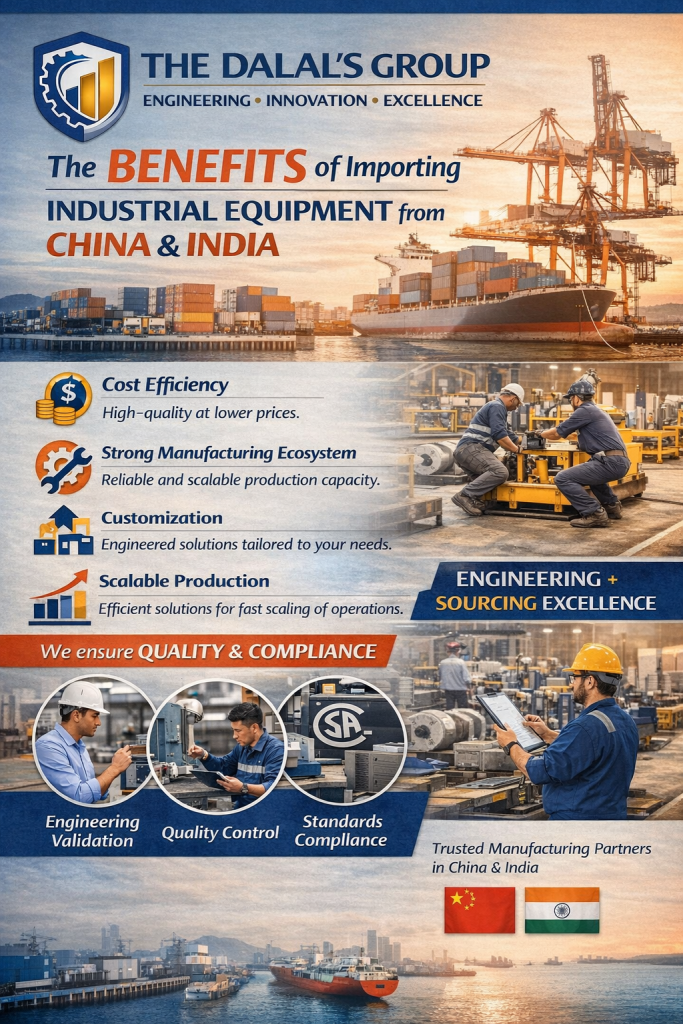
In today’s competitive manufacturing environment, businesses are constantly looking for ways to reduce costs, improve efficiency, and stay ahead of the competition. One of the most effective strategies is global sourcing of industrial equipment, particularly from countries like China and India.
However, successful importing is not just about lower costs — it’s about finding the right balance between quality, reliability, and engineering performance.
1. Cost Efficiency Without Compromising Value
One of the primary advantages of sourcing from China and India is cost savings. Due to lower manufacturing and labor costs, businesses can access equipment at significantly reduced prices compared to local sourcing.
When done correctly, this does not mean compromising on quality — it means achieving better value for the same investment.
2. Access to a Wide Manufacturing Ecosystem
China and India offer well-developed manufacturing ecosystems with the capability to produce a wide range of industrial equipment and custom-engineered solutions.
This allows businesses to source both standard and fully customized solutions.
3. Customization and Flexibility
Manufacturers in these regions often provide greater flexibility in:
- Custom designs
- Small to medium batch production
- Modifications based on specific operational needs
This is particularly valuable for companies requiring tailored solutions rather than off-the-shelf products.
4. Faster Scaling of Operations
Global sourcing enables businesses to quickly scale operations by:
- Reducing lead times for bulk production
- Accessing multiple suppliers
- Expanding production capacity without major capital investment
5. Engineering-Driven Sourcing (The Critical Advantage)
While sourcing offers many benefits, the real value comes when it is backed by engineering expertise.
Without proper technical validation, imported equipment can lead to:
- Structural failures
- Poor ergonomics
- Inefficient workflows
- Increased maintenance costs
This is why engineering review and validation is essential before sourcing.
6. Quality Control and Compliance
With the right approach, businesses can ensure:
- Compliance with required standards
- Proper material selection
- Structural integrity
- Performance reliability
Where The Dalal’s Group Can Help
At The Dalal’s Group, we bridge the gap between sourcing and engineering.
We support our clients by:
- Identifying reliable manufacturers in China and India
- Reviewing designs from an engineering perspective
- Validating load capacity, structure, and usability
- Assisting with custom material handling equipment
- Ensuring products meet Canadian standards and operational requirements
- Supporting end-to-end implementation, from concept to delivery
Our approach ensures that what you source is not just cost-effective — but also safe, reliable, and built for your specific operations.
Conclusion
Importing industrial equipment from China and India offers significant advantages — from cost savings to customization and scalability. However, the key to success lies in combining global sourcing with engineering expertise.
 thedalalsgroup.com
Leave a comment